AN ALBUM / A FIELD / SIX ENCOUNTERS
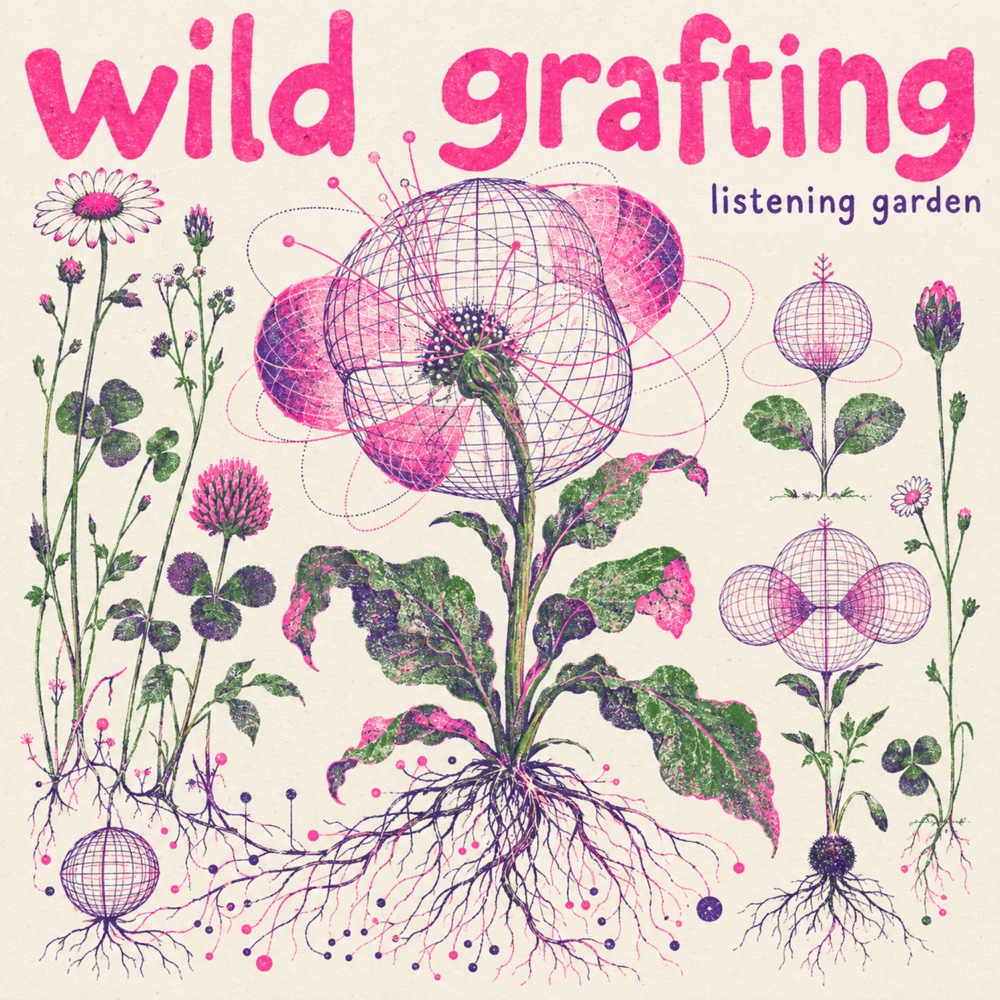
wild
grafting
An unlikely garden of sounds.
String phrases pick up fractured attacks. Percussion learns contour, hesitation and breath. Each leaves something behind in the other.
Hairline
Opening · 32 secondsBegin here. Follow the line as the first fractures enter.
HOW A LIBRARY BECOMES MUSIC
A sound arrives with a history.
A musical role begins with a need: hold a line, give a gesture weight, answer with an edge. The library brings a sound with its own attack, grain and internal movement. That choice starts to shape the piece before the sound is transformed.
“I'm fascinated by the unexpected combinations and unlikely paths through which the sample library answers the composition's musical roles.”
Listening Garden
There is room for chance, but also for listening and selection. A surprising candidate can change the character of a phrase. Its timing, articulation and place in the field then help it take on a musical role.
Same material, another way of speaking.
In these two passages, a shared source appears in contrasting roles. Listen for a family resemblance between the brief, broken gestures and the longer lines.
Hairline
1:02–1:12 · 10 secondsA small string-like fracture reappears as a lower percussive gesture.
Bow to Burr
4:08–4:20 · 12 secondsA short guttural gesture and a longer bow-shaped note share their source.
Look closer: what is shared?
These gestures use the same library material within each pair. The longer gesture is not a recording of the shorter one stretched out: each is made separately for its place in the phrase. Kinship can survive a change in pitch, length and touch.
STUTTER BOTANY
Keep the turns.
Change the reach.
A five-note idea returns in different forms. Its line still turns up, down, up, down, but the steps grow wider or closer together. The phrase can feel related without giving away exactly where it will go.
Listen through the passage, then move between the drawings. Try following the gesture instead of memorizing individual notes.
Stutter Botany
1:55–2:45 · 50 secondsListen for related turns with a changing reach.
Changed, but still related
This five-note idea keeps turning in the same directions. Its leaps change size, and its last appearance moves twice as quickly.
Follow the shape: up, down, up, down. The pale lines hold the other phrases in view.
A closer look at the relationship
Every drawing uses the same pitch scale. The entrances keep their relative positions in time, even when the final phrase takes half as long. The selector changes the drawing only.
Keeping the direction of each step does not keep every relationship between the pitches. That is one way the phrase can stay familiar while becoming less predictable.
AMBISONICS / ONE SHARED FIELD
The space belongs
to the phrase.
A steady voice gives a wandering one something to move against. Position, width and movement become part of the arrangement, alongside pitch and rhythm.
All of the voices meet in one ambisonic field. That field is shaped together, then rendered into the two ear channels of the headphone mix. Listen while the drawing follows a short passage from Stutter Botany.
Follow a sound through the field
Play this moment from Stutter Botany. Five voices share one sphere, each with its own color and path.
16 seconds · headphones welcome
Drag to turn the view. The music stays the same.
Hide a voice to follow another more easily. This changes the drawing; you still hear the complete mix.
See the passage at a glance
Sixteen moments, one second apart. Tap a sphere to go there in the recording.
What does the sphere show?
These are the directions written into the arrangement for five selected voices. Each linked pair of dots shows the two sides of a stereo source. The dotted trail follows its recent movement.
The sphere is a map of the composition, not a measurement of where you will hear a sound. Distance from the center does not mean loudness or distance from the listener. A note’s tail can continue after its marker opens.
The camera begins at a fixed angle. Turning it changes your view of the drawing, not the binaural recording.
Look closer: what does binaural mean here?
The album was composed in a three-dimensional sound field. Its released two-channel mix carries a headphone rendering of that field. You can play it as an ordinary stereo recording; headphones keep the left- and right-ear signals separate.
The drawing shows the arrangement's stored directions. It helps explain how the voices relate in space; the sense of location you hear will also depend on your headphones and your own hearing.
BOW TO BURR / SHADE AT FULL SPEED
Speed can leave room.
Fast activity does not have to take over the whole space. In Bow to Burr, the quiet, fast passage asks for attention through detail. In Shade at Full Speed, a brief forceful moment gains its setting from the time around it.
Keep a comfortable volume across both excerpts. Notice how much is happening, and how much room the piece still gives you.
Bow to Burr
3:10–3:33 · 23 secondsFollow the quick activity inside this quieter passage.
Shade at Full Speed
2:16–2:40 · 24 secondsHear the interruption with the material around it, rather than as an isolated hit.
GUTTER CANTUS
The opening
learns to sing.
A rhythm can remain recognizable after its sound and pace change. Here, uneven spaces between the opening accents return inside a more lyrical phrase near the end.
Hear the opening first, then the closing passage. Can you feel the same lopsided step inside the longer line?
Gutter Cantus · opening
0:00–0:10 · 10 secondsListen for the unequal spaces between accents.
Gutter Cantus · return
5:00–5:30 · 30 secondsThe inherited spacing enters in the final phrase.
The opening learns to sing
In Gutter Cantus, the opening’s sharp accents leave a trace in the closing melody. Their spacing opens out, but the uneven pattern survives.
The little gaps stay little; the larger gaps stay larger. The same relationship passes into a different kind of gesture.
What carries across?
The closing phrase borrows the proportions between the opening’s entrances. It uses different sound material. The drawing stretches the timing of those entrances, not the notes’ lengths or timbres.
The final span is seven seconds, just over five times the opening’s. Moving this slider explores that relationship; it does not alter the recording.
HAIRLINE / WILD GRAFTING
Remembering
without completing.
The final track recalls the opening's first four notes and their lead sound. The fifth note of that original figure is left out. Something familiar returns, with part of its answer still missing.
Go back to the album's beginning, then hear the last passage. The rest of the arrangement continues around that incomplete gesture.
Revisit Hairline's openingWild Grafting
4:40–5:00 · 20 secondsFollow what returns, and where the familiar phrase leaves an opening.
COMPANION ALBUM / SIX PIECES / 30 MINUTES
Wild Grafting
with the Garden Voices
One composition, another cast. These six pieces return to the album’s original score, drawing from a different collection of appropriated short samples, many containing voices. New sounds take on the same musical roles.
The written notes, timing and paths through the ambisonic field stay in place. Each new sound is shaped to fit its part, bringing a different grain, attack and sense of weight. Listen for what survives the change of material: a familiar contour, an uneven step, a breath between gestures.
This is a complete companion album. Begin with Hairline Murmurs and follow it through, or choose a piece below.
01 / Hairline Murmurs
from Hairline
Carry the connections
back into the album.
These are small windows into six complete pieces. Listen again without watching the drawings. Notice which relationships stay with you.
Listen to the album on Bandcamp
- Hairline 4:00
- Bow to Burr 5:00
- Stutter Botany 4:30
- Shade at Full Speed 6:00
- Gutter Cantus 5:30
- Wild Grafting 5:00
Keep this companion
On a phone, open the web booklet for the music and moving drawings. The PDF includes the same link and a QR code.
On a computer, you can also unzip the complete folder and open Open Wild Grafting.html. Keep its assets folder beside it. The PDF sits alongside the launcher, ready to read.
Download the complete offline folder